
GN043 Epitaph of Severus
Reference CLE 1201 | Description | Type of letters | Location | Chronology | Epigraphic edition | Translation | Apparatus | Commentary | Type of verse | Text divided into verses and metric signs | Images | Bibliography | Link to DB | Author |
GN043 Epitaph of Severus
Description
- Idno filename 20/04/0059
- Type of inscription: Sepulcralis
- Support: Stela
- Material: Limestone Material Description: Limestone (Huard) with an arched top.
- Conservation status: Two fragments are preserved. The lower part is wider and the upper part is slightly leveled. The inscribed face shows numerous damages.
- Dimensions height/width/depth (cm): 102/49/13.8
-
Epigraphic field:
- Layout: The 'ordinatio' is centered. It features 'hederae' and triangular punctuation marks.
- Epigraphic field dimensions hieght/weight (cm): 30.5/39
- Preserved
Type of letters
- Letter size:6 to 6,6 / 4,4 to 4,8 / 3,4 / 1,7 to 2,2 / 1,7 to 2,1 / 1,8 to 4,5 / 2 to 2,5 cm
- Description of the letters:The writing is irregular, not very elegant, except for the 'praescriptum.' Some graphemes, such as the P or the T, may suggest a fairly late dating. There are connections and letters with peculiarities: MA in 'mater' (lines 2-3); long I in 'condidit' (lines 6-7).
Location
- Place of discovery: It comes from Arles, on the outskirts of 'St-Pierre-de-Mouleyres' (district of 'Aliscamps) (FOR). Discovered shortly before the summer of 1854 (Baumeister). First mentioned in a German journal in 1855.
- Geolocation
- Conservation location: Preserved in the Museum of Ancient Arles, in the storage.
- Inventory number: P571.
- Location with Modern Nomenclature Francia
- Location with Old Nomenclature Gallia / Narbonensis / Arelate
Chronology
- Inscription's dating: Between year 1 and year 99
- Dating explanation: Only one editor, Cholodniak, proposes a dating, the time of Augustus, but without any justification. We think it is from the 1st century, solely based on some paleographic indications.
Type of verse
- Type of verse: Elegiac couplet
- Verse/line correspondence: No
- Prose/verse distinction: No
Epigraphic edition
Seuero
Romula ❦ ? ⁽ma⁾-
ter
hoc pietatis ▴ opus ▴ fecit
5 tibi ▴ nate sepulcrum ❦
lect˹a˺quẹ ṣollicita ▴ condi-
dit ossa ▴ manu ❦
Text divided into verses and metric signs
hoc pietatis opus fecit tibi, nate, sepulcrum qww|qww|q/q|q/ww|qww|qq
lecteque sollicita condidit ossa manu. qww|qww|q||qww|qww|q
Translation
For Severus, from his mother Romula. For you, son, this tomb, a work of piety, made this tomb for you, and in a quiet manner she buried your bones with a troubled hand.
Bibliography
BAUMEISTER 1855 ; HUARD 1874, 648 ; HIRSCHFELD (lecture conjointe avec Mommsen), CIL XII, 879 ; BÜCHELER, CLE, 1201 (CHOL. CSLE, 619) ; BENOIT 1936, 160 ; TOLMAN 1910, 22 ; GALLETIER 1922, 211 ; HOOGMA 1959, 46, 146, 354.
Apparatus
1 om. Baumeister, quod fragmentum superius defuerit opinor • Seuero Huard || 2 incertum utrum hedera sit an anaglyphum quoddam || 3 ter • Huard || 5 nata Baumeister nate • Hirsch. na+[·] lapis || 6 lecti [—]ota condi Baumeister lecteque sollicita Hirsch. lectaque sollicita corr. Büch. lectequẹ ṣollicita lapis || 7 dit • Hirsch.
Commentary
Hoogma believes that the beginning of verse 1 comes from a combination of two lines from Virgil: hoc virtutis opus (Aen. 10, 469) and hic pietatis honos (Aen. 1, 253), which together yield hoc pietatis opus. However, the complete expression pietatis opus appears in Martial: Non fuit hoc artis, sed pietatis opus (MART. Epigr. 16, 2). Verse 2 would come from a modification of the composition order of another line from Virgil: ossaque lecta cado texit Corynaeus aeneo (Aen. 6, 228). Hoogma also refers to VERG. Aen. 5, 45 s., regarding buried bones: ossa […] condidimus. But the expression ossa lecta also appears in the work of Seneca: non ossa tumuli lecta discreti tegunt (SEN. Oed. 66). As for this second line, with the exception of Propertius (illa, qua vicit, condidit arma manu: PROP. 2, 16, 42), the literary parallels are divided mainly between Ovid and Martial: dicite, quis Tereus, quis vos inritet Iason / figere sollicita corpora vestra manu? (OV. Am. 2, 14, 34); moenia felici condidit alta manu (OV. Am. 3, 13, 34); et datas sollicita tura perire manu (OV. Fast. 6, 370); Ecquid ubi e Ponto nova venit epistula, palles, / et tibi sollicita soluitur illa manu (OV. Trist. 5, 2, 2); Invicta quidquid condidit manus, caeli est (MART. 9, 1, 10); Frangere dum metuis, flecos crystallina: peccant / securae nimium sollicitaeque manus (MART. 14, 111).
Hoc opus and opus hoc are quite common in the CLE. The only other pietatis opus is read in Rome: saepe salutis opus pietatis muner iuuit (CLE, 1414).
Only the first two words of verse 2 pose an interpretation problem, following a probable error by the stonecutter, who engraved lecteque. Editors generally corrected it to lectaque, but Bücheler points out that one can imagine the error being based on the following word, to read sollicite.
The main stylistic device of this carmen could be hyperbaton, used on three occasions: sepulcrum… opus; lecta… ossa; sollicita… manu.
Images
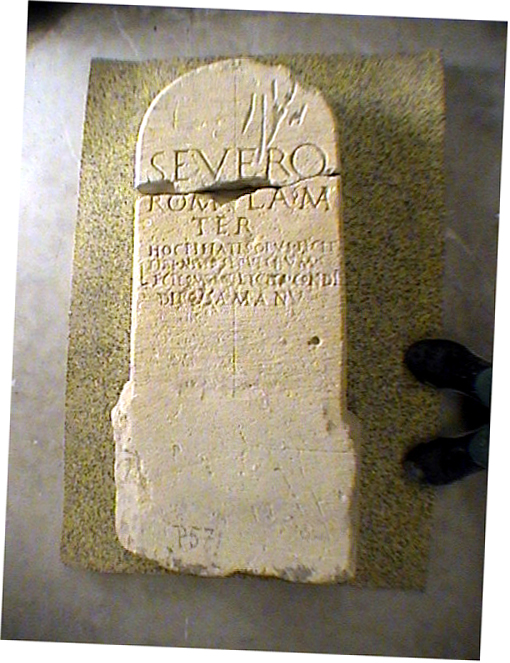 Photo author: H. Belloc.
Link to DB



Author
- Author:H. Belloc
- Last Update2026-02-24 08:27:56
- Autopsy date:2002
You can download this